A virtual replica of a sluice. Source: Cimpro on CSDN.
 David Zhou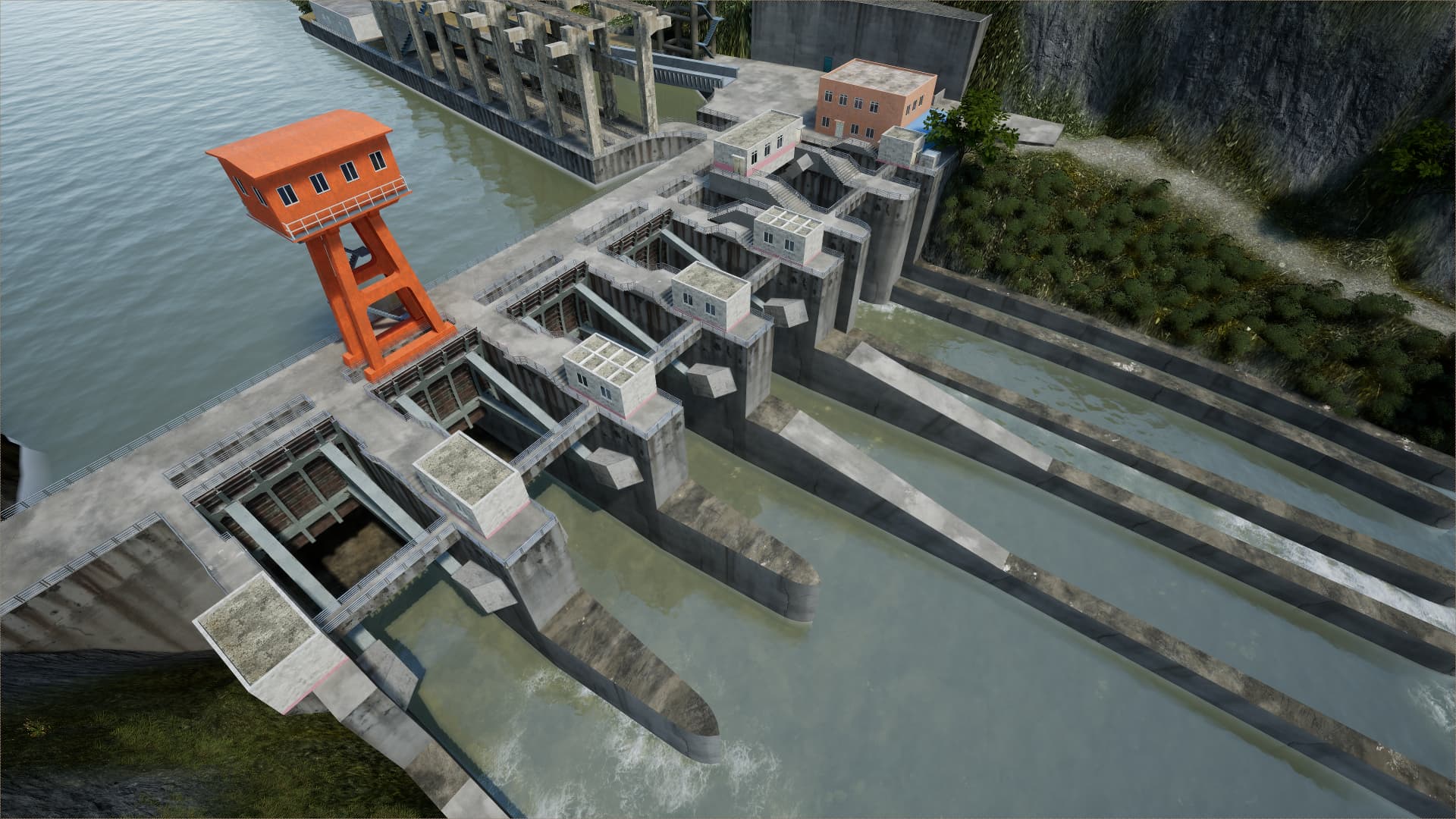
If you ask Chinese water managers about what the defining buzzword of the past few years has been, many would likely answer: “digital twins.”
A digital twin, according to McKinsey, is “a digital replica of a physical object, person, system, or process, contextualised in a digital version of its [realtime] environment”. This definition highlights two key elements of the concept: digital replica and realtime context. Digital twin technology has become widely used in sectors such as manufacturing and energy systems, for purposes including failure detection, operational optimisation, and predictive maintenance.
In the context of water systems, digital twins seem to promise revolutionary breakthroughs. Given appropriate application and data availability, water digital twins could enable substantial improvements in water management practices such as flood forecasting, reservoir operation, water allocation, and infrastructure monitoring. In theory, water digital twins are supposed to encapsulate all water-related processes, including hydrology, ecological impacts, human activities, and the operations of engineering facilities, and therefore, via continuous data assimilation, enable us to manage complex processes, test scenarios, simulate interactions, and perform high-dimensional optimisation.
However, the rapid rise of the concept in China’s water sector also shows several indications of a technological hype cycle. Water digital twins received relatively little attention in the academic literature until recently. If you search for “digital twins” and “water conservancy” in Chinese on CNKI, China’s centralised database for academic publications, you will notice that the concept only began attracting substantial attention after 2021. Publications on this topic grew quickly to exceed 1,000 in 2025. The abruptness of this shift reflects how research and technical priorities in China’s water sector can be rapidly reoriented towards concepts endorsed by senior political leadership, in this case through Water Minister Li Guoying’s visible interest in digital twins.
Minister Li has been a particularly strong advocate of river-basin digital twins. After becoming China’s water minister in early 2021, he brought digitisation and smart systems, as one of the keys to his shake-up plan, to the top of the ministry’s agenda. For his understanding of smart water management, digital twins of river basins are cornerstones to build his visions on. They should be “full-factor digital mappings of the physical river basins with dynamic real-time interaction and fusion of information between the physical and the digital sides.” Enthusiasm from the top leadership quickly turned into real-world investment in the field. Though public data is difficult to collect, procurement and bidding records show a clear peak in investment at the end of 2024, before entering a sharp decline in 2025.
The outputs from the massive investment so far are numerous, including digital twins of 94 pilot basins (inclusive of the Yangtze and Yellow River Basins), 11 key water projects (Three Gorges, South to North Water Diversion, Xiaolangdi, Danjiangkou, etc), 49 large-scale irrigated areas, and 230 rural water supply projects. Impressive infrastructure for monitoring and data collection has been developed, consisting of 34 remote sensing satellites, 212 precipitation radars, 133,000 ground hydrological stations, and over 300,000 safety monitoring points of water projects. I deliberately use the word “output” here, as the digital twins that have been developed, to my understanding, are tools, not purposes. However, the official discourse seems rather stingy to offer any insights further than that.
Evidence-based analysis of outcomes or benefits is scarce in official speeches or publications. Journal articles such as that by Cai Yang, former director of the Ministry’s informatics centre, document notable advances in capabilities, in particular the “four cornerstone” ones in forecasting, warning, simulation, and contingency planning. Minister Li’s own speeches at China’s annual official conference for water management from 2022 to 2026 also highlighted abundant outputs and improved capabilities, instead of comprehensive benefits that could be measured.
A counter-argument might be that, on one hand, these projects are relatively new and benefits might take much longer to materialise, and on the other, outcomes are apparently difficult to measure given the complexity of the water systems. Both points are valid. Yet they also expose a tension in the rhetoric surrounding digital twins. Because, if a water digital twin is genuinely a data-driven replica of the physical object and its realtime context, it should be able to make such measurements easier through simulation of alternative scenarios.
Beyond questions of effectiveness lies a second issue: the governance philosophy embedded in many discussions of water digital twins. The debate is not only about what these systems can do, but also about how decisions should be made once such capabilities exist. Some Chinese researchers in this field argue that development of reliable water digital twins makes it imperative to adopt “forceful top-down implementation”, so as to warrant centralised coordination, consistent standards and policies, and most importantly, equity.
Water systems are apparently complex and require integrated approaches. However, this is the exact reason for distributed adaptability, local community engagement, and institutional diversity. Such technocratic believes about governance are criticised as being reductionistic and technocratic imagination. Better data and models could essentially improve the digital twins to raise situational awareness, but decision-making processes are inherently political, value-laden, and always embedded in social and historical contexts, within which, ironically, great uncertainties are admitted by the same group of researchers. Historical water management practices, as ancient as the Angkorian water networks and as recent as Soviet river-engineering mega projects, have repeatedly reminded us that many failures arose from the fragility of highly centralised control systems, not the lack of data.

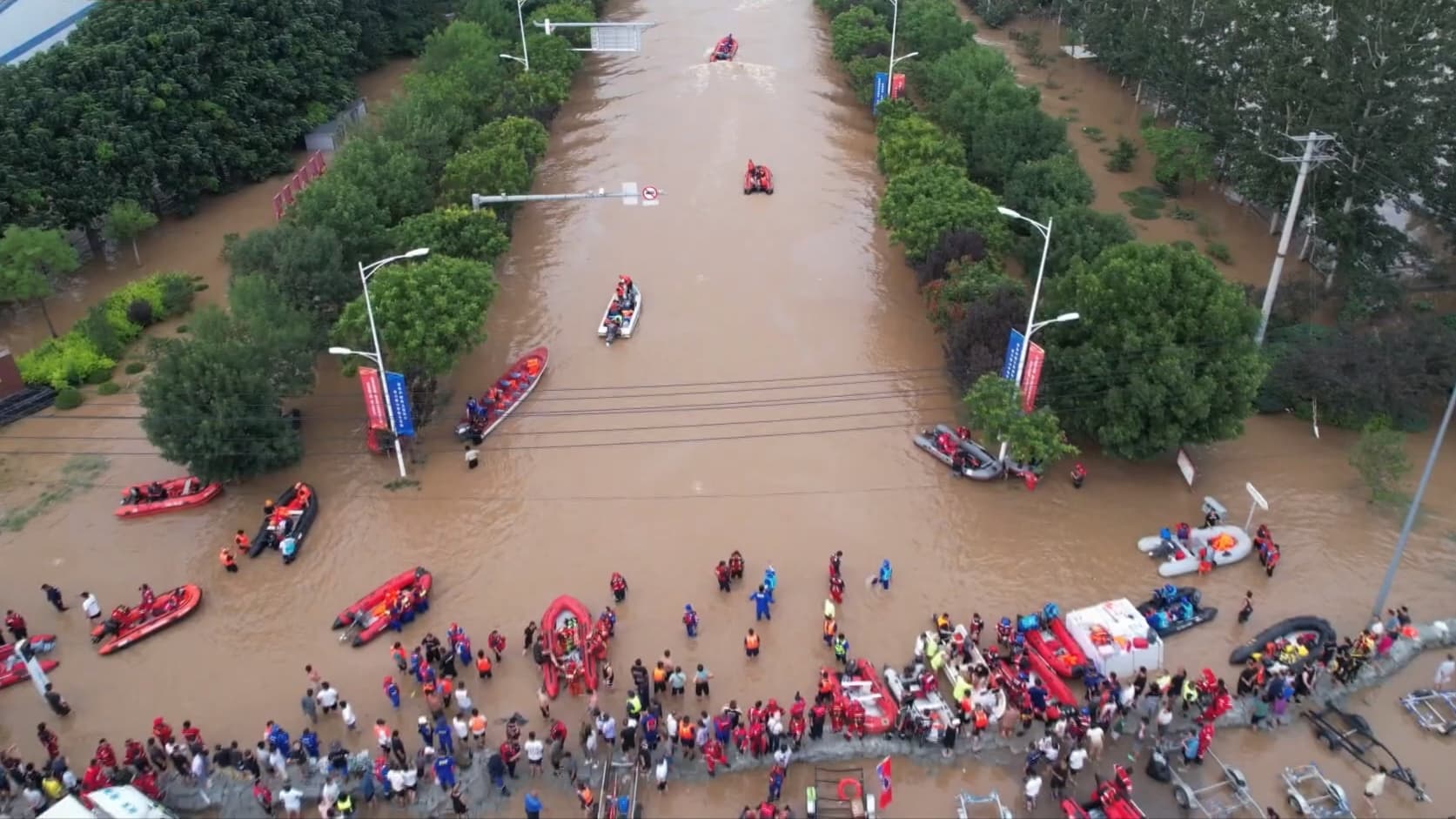
While government-driven and top-down implementation plays an essential part in ensuring equal access to resources, discarding bottom-up and participatory policies often leads to quite opposite outcomes. China’s own implementation of water digital twins are an explicit proof to that. Access to water digital twins currently are limited to governmental players only, leaving the public and other stakeholders out of the picture, and therefore, excluded from information and decision-making. One may argue that they are eventually receiving benefits of improved decisions, for instance, for flood relief, but these benefits would often be dependent on perspectives and values where winners and losers are created unwillingly, in particular the latter, as stackholding parties are always not a homogeneous group, to which the 2023 flooding in Haihe River basin of Northern China attests.

So far, China’s water digital twin programme has attracted considerable hype, including rapid policy-driven expansion and a strong emphasis on outputs and capabilities. Whether these investments will ultimately translate into measurable improvements in water governance, with little evidence-based analysis currently available, is still to be observed. Theoretically, the technology could be a promising enabler for improving water management decisions. However, its success would be highly dependent on institutional arrangements that should not rest entirely with government-led top-down approach.
Comments